China Stocks Crash Shocks Markets: What Happened and What’s Next?
About $1.1 trillion in market value vanished from Chinese stocks in a single brutal sell-off, according to Bloomberg’s market value estimates. By the closing bell, almost every listed company on the mainland finished in the red.
That is the kind of market day that gets everyone’s attention, even people who do not normally follow Chinese equities.
The sell-off hit mainland China and Hong Kong at the same time. It dragged down big indexes, punished technology and property shares, and raised a familiar question for investors everywhere: is this a short-term panic, or a sign of deeper trouble?
Here is what happened, why it happened, how it rippled through global markets, and what investors can watch next.

What happened
The sharp drop came on April 7, 2025, when Chinese and Hong Kong shares sold off heavily after a new wave of U.S.-China trade tensions shook investor confidence.
According to Reuters and Bloomberg reports from that trading session, the damage was broad:
Index | Market | Reported move on April 7, 2025 |
Shanghai Composite | Mainland China | Down about 7.3% |
Shenzhen Component | Mainland China | Down about 9.7% |
CSI 300 | Mainland China | Down about 7.1% |
Hang Seng Index | Hong Kong | Down about 13.2% |
The Hang Seng Index suffered one of its worst one-day drops in decades. Hong Kong’s market was hit especially hard because it has a large concentration of technology, internet, financial, and China-linked companies that global investors can trade more easily.
The mainland sell-off was also severe. The Shanghai Composite tracks many large companies listed in Shanghai. The Shenzhen Component has more exposure to growth shares, manufacturers, tech firms, and smaller companies. The CSI 300 follows 300 of the largest companies listed in Shanghai and Shenzhen, so it is often treated as a broad gauge of China’s blue-chip market.
In simple terms, all the major gauges were flashing red.
The hardest-hit areas included:
Technology and internet stocks, especially in Hong Kong
Property developers and related financial firms
Export-heavy manufacturers
Consumer and travel shares
Brokerages and other market-sensitive financial stocks
Materials and industrial companies tied to global demand
Market breadth was striking. “Breadth” just means how many stocks are rising versus falling. On this day, the sell-off was not limited to a few weak companies. It spread across almost the entire market.
That matters because broad selling often signals fear, not just a normal reshuffling between sectors.
Why it happened
No single factor caused the crash. Markets usually fall this hard when several worries collide at once. In China’s case, investors were already nervous before the latest shock arrived.
Trade tensions lit the match
The immediate trigger was the renewed U.S.-China trade fight.
In early April 2025, the U.S. announced a new round of tariffs, and China responded with retaliatory tariffs on U.S. goods. Reuters reported that China said it would impose a 34% tariff on U.S. imports after the U.S. announced higher duties on Chinese goods.
A tariff is a tax on imported goods. If tariffs rise, companies that export goods can face weaker demand, lower profits, or higher costs. Investors often sell export-linked stocks when they expect trade barriers to hurt earnings.
China is deeply tied to global trade, so this kind of escalation hits investor confidence fast.
Weak economic data added pressure
The trade shock landed on top of existing concerns about China’s economy.
Investors have been watching several soft spots:
Slower consumer spending
Weak private-sector confidence
Deflation pressure in some parts of the economy
Uneven factory activity
Youth unemployment concerns
Lower business investment
When growth looks shaky, stocks become more vulnerable. Investors start asking whether companies can keep growing profits. If the answer looks uncertain, share prices often fall.
The property sector is still a drag
China’s property sector remains one of the biggest concerns.
For years, real estate was a major engine of China’s growth. Developers borrowed heavily, local governments relied on land sales, and households stored a large share of wealth in apartments.
That model has been under pressure since major developers began defaulting and home sales weakened. Property weakness affects more than builders. It can hurt banks, construction firms, steel demand, household confidence, and local government finances.
So when the market is already worried, property names often get sold first.
Investors wanted stronger policy support
Chinese officials have introduced support measures over time, including steps to stabilize markets, help property activity, and support lending. But investors often want bigger or clearer action during periods of stress.
Markets tend to react poorly when policy signals feel vague.
Investors were looking for signs of strong fiscal support, meaning government spending or tax relief, and monetary support, meaning lower interest rates or easier credit. Without a clear fresh package, some traders chose to sell first and wait for details later.
Sentiment was fragile
Investor sentiment is just the market’s mood.
When investors feel confident, they look past bad news. When confidence is weak, even one negative headline can trigger heavy selling.
China’s stock market had already gone through years of stop-start rallies, policy hopes, and disappointments. That history matters. After repeated false starts, investors can become quick to take profits and slow to buy dips.
That is one reason the move became so sharp.
Capital outflows made the move worse
Capital outflows happen when investors move money out of a market and into other assets or countries.
Foreign investors can reduce China exposure through Hong Kong shares, exchange-traded funds, futures, and other channels. Domestic investors can also seek safer assets when volatility rises.
When many investors try to leave at once, prices can fall quickly. Selling creates lower prices, lower prices create more fear, and the cycle feeds on itself.
That does not mean every seller had the same reason. Some were reacting to tariffs. Some were cutting risk. Some were forced to sell because of trading rules or margin calls.
A margin call happens when an investor borrowed money to buy stocks, and falling prices force them to add cash or sell shares. During sharp sell-offs, margin pressure can add fuel to the fire.
Global ripple effects
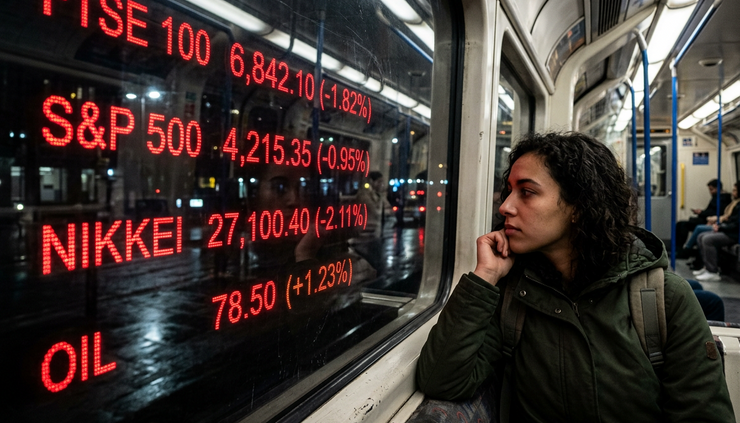
China is the world’s second-largest economy, so a market shock there rarely stays local.
The sell-off spilled into other Asian markets first. Japan, South Korea, Taiwan, and Australia all came under pressure as investors reduced risk across the region. U.S. and European futures also weakened during the global trading day as investors reassessed exposure to trade-sensitive companies.
Currencies moved too.
The offshore yuan weakened as traders priced in slower growth and trade risk. A weaker yuan can help exporters by making Chinese goods cheaper abroad, but it can also worry investors if it looks like money is leaving the country.
Commodities also felt the pressure.
China is a major buyer of raw materials, including oil, copper, iron ore, and soybeans. When investors fear slower Chinese growth, commodity prices often fall because demand expectations drop.
That is why a China stock rout can hit:
Copper miners
Oil producers
Industrial exporters
Luxury goods companies
Emerging-market currencies
Global funds with China exposure
The ripple effect does not mean every global market will follow China lower. It means China is large enough that investors everywhere have to pay attention.
What investors should do
A frightening market day can push people into rushed decisions. That is usually when mistakes happen.
Here are practical steps to think through calmly.
Avoid panic selling
Selling in a panic can lock in losses at the worst possible time.
That does not mean every stock will recover quickly. Some companies may face real earnings pressure. But broad market sell-offs often include good companies, bad companies, and everything in between.
Before selling, ask a simple question: has the long-term reason for owning this investment changed, or am I reacting to fear?
Diversify across markets and assets
Diversification means not putting all your money in one place.
A portfolio concentrated in one country, one sector, or one theme can swing wildly. China exposure can still make sense for some investors, but it should fit within a broader plan.
Diversification can include:
U.S. stocks
International developed-market stocks
Emerging-market stocks
Bonds
Cash or money market funds
Commodities or real assets, depending on risk needs
The goal is not to avoid every loss. The goal is to avoid one market event wrecking the whole portfolio.
Think long term
China’s market has gone through powerful rallies and painful declines before. Short-term political and economic headlines can move prices fast, but long-term returns depend more on earnings, valuations, policy, and growth.
If your time horizon is measured in years, one bad trading day should not automatically change your plan.
If your time horizon is measured in weeks, the risk is much higher.
Consider dollar-cost averaging
Dollar-cost averaging means investing a fixed amount at regular intervals, such as every month.
This approach does not guarantee profits. It can still lose money in a falling market. But it can reduce the pressure of trying to pick the perfect entry point.
For investors who want China exposure but feel nervous about volatility, gradual buying may be safer than making one large purchase all at once.
Check your risk tolerance
Risk tolerance means how much loss you can handle financially and emotionally.
A market crash is a real-world test. If a 7% to 13% one-day drop makes you feel forced to sell everything, your portfolio may be too risky for your comfort level.
Cash needs matter too. Money needed soon should generally not be exposed to high market volatility.
This article is for general information only and is not financial advice. Consider speaking with a qualified financial adviser before making investment decisions.
What to watch next
The next few weeks and months matter because investors will look for proof that the sell-off was either overdone or justified.
Government stimulus
Watch for new fiscal measures from Beijing.
Stimulus can include public spending, consumer support, help for local governments, or more direct support for the property market. Investors will care about both size and timing.
A large package with clear details could calm markets. A vague message may not be enough.
Central bank policy
China’s central bank, the People’s Bank of China, can support the economy through lower interest rates, lower reserve requirements for banks, or liquidity injections.
Liquidity simply means money available in the financial system. More liquidity can make it easier for banks to lend and investors to buy assets.
Property market data
Housing sales, home prices, developer debt updates, and land auction activity will stay in focus.
If property keeps weakening, it may drag on confidence. If sales stabilize, investors may become more willing to buy China-linked assets again.
Economic reports
Key reports to watch include:
GDP growth
Retail sales
Industrial production
Fixed-asset investment
Inflation data
Export and import numbers
Manufacturing and services PMI readings
PMI stands for Purchasing Managers’ Index. It is a survey that gives a quick read on business activity. A reading above 50 usually signals expansion. A reading below 50 signals contraction.
Trade policy headlines
Markets will keep reacting to tariff news, negotiations, and official statements from Washington and Beijing.
If tensions ease, stocks could rebound. If the trade fight escalates, volatility may stay high.
Capital flow data
Foreign investor flows into and out of Chinese and Hong Kong stocks will offer clues about confidence.
If money starts returning, it may signal bargain hunting. If outflows continue, investors may stay defensive.
The clear takeaway
China’s $1.1 trillion stock market wipeout was not just a bad day on a chart. It reflected a pileup of concerns: trade tensions, weak confidence, property stress, policy uncertainty, and money moving out of riskier assets.
The sharp falls in the Shanghai Composite, Shenzhen Component, CSI 300, and Hang Seng Index show how quickly fear can spread when investors lose patience.
For everyday investors, the main lesson is simple: do not let one dramatic market day force an emotional decision. Review your risk, stay diversified, and watch the next policy and economic signals closely.
Sources: Reuters market reports from April 7, 2025; Bloomberg market value estimates and index coverage; Hang Seng Indexes closing data; China Securities Index Co. data; Shanghai Stock Exchange and Shenzhen Stock Exchange market data.


